
Description
During the American Civil War, military insignia was meticulously standardized, but few badges carried as much weight, rarity, and historical significance as the Lieutenant General shoulder strap.
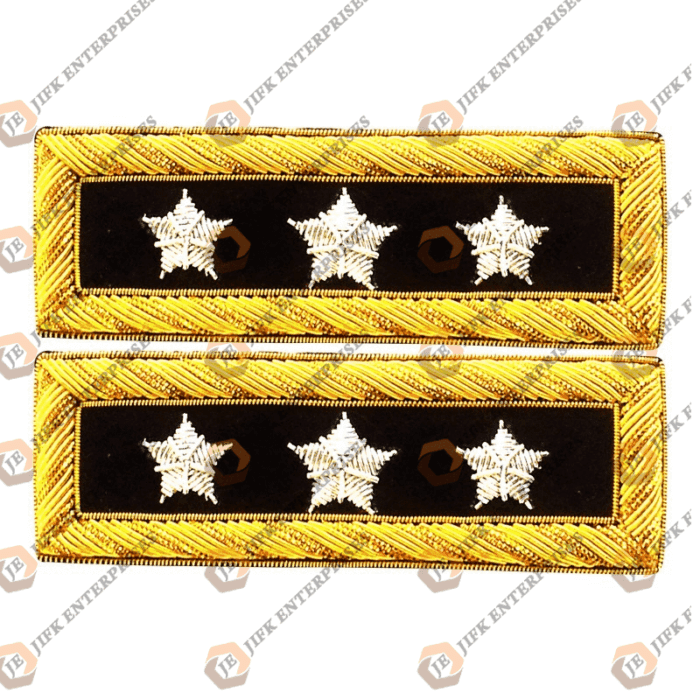
Worn on the shoulders of an officer’s frock coat, this rectangular badge featured a dark blue velvet background enclosed by an ornate, embroidered gold border. Inside the border were three silver, five-pointed stars.
While it looks straightforward by modern military standards, during the 1860s, this specific badge represented the absolute pinnacle of command in the United States military. To understand its impact, one must understand both its design and the intense political history behind it.
The Union Design (The Shoulder Strap)
The Union Army utilized a system of shoulder straps ($1\frac{3}{8}$ inches wide by $4$ inches long) to denote rank, with the background color indicating the branch of service. Because a Lieutenant General was a general officer of the entire line, the background was a rich, dark blue velvet.
-
Star Arrangement: The three silver stars were arranged horizontally. In standard regulations, the center star was slightly larger than the two flanking stars.
-
Placement: These were worn in pairs, securely stitched onto the shoulders of the officer’s double-breasted frock coat.
The Historical Rarity of the Rank
To truly appreciate this badge, you have to understand that when the Civil War broke out in 1861, nobody was legally allowed to wear it.
The United States was deeply superstitious of high military ranks, fearing it could lead to a military dictatorship.
-
George Washington had held the rank of Lieutenant General during the American Revolution.
-
Winfield Scott was given the rank in 1855, but only as a brevet (honorary) promotion, meaning he didn’t receive the actual authority or pay of a full Lieutenant General.

Reviews
There are no reviews yet.